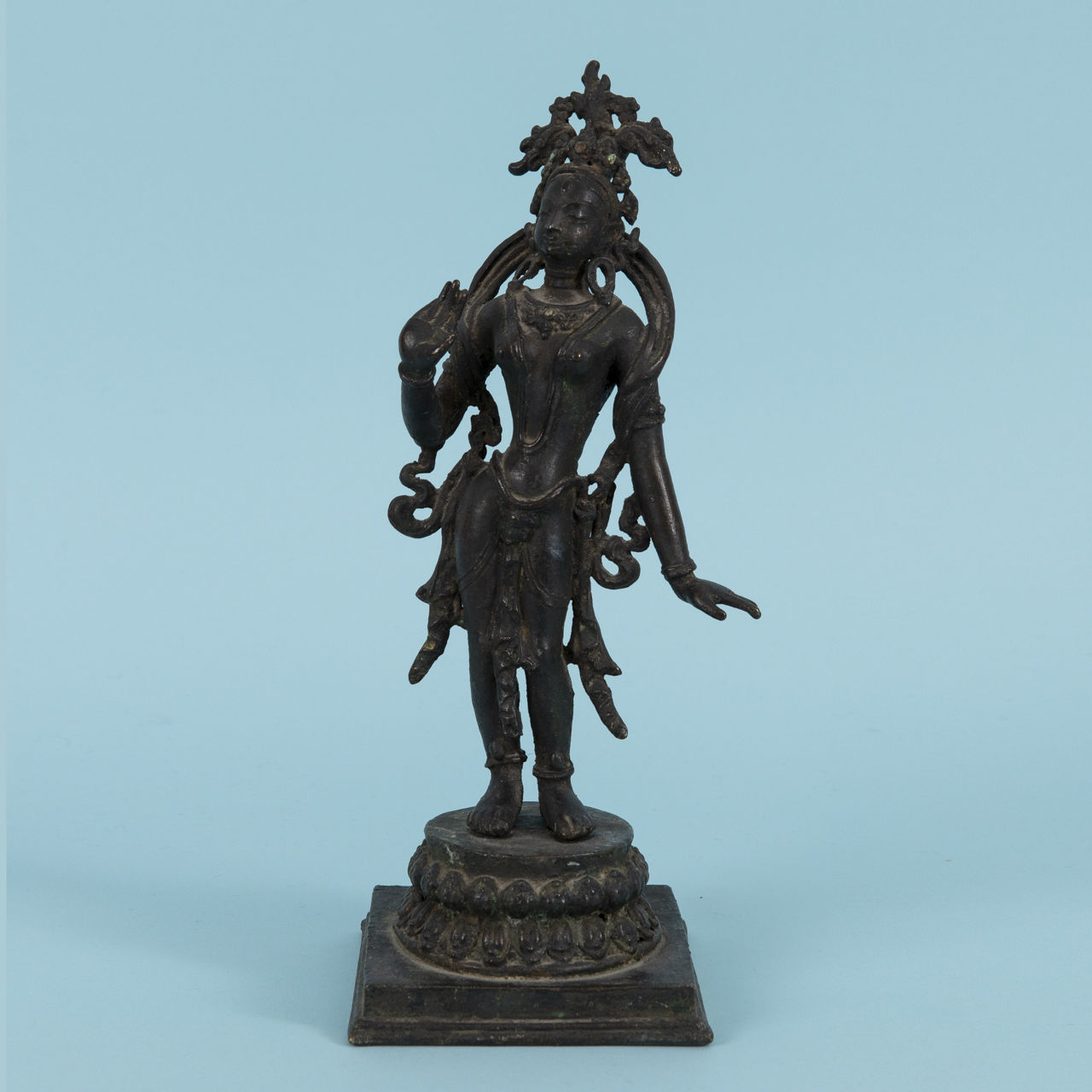
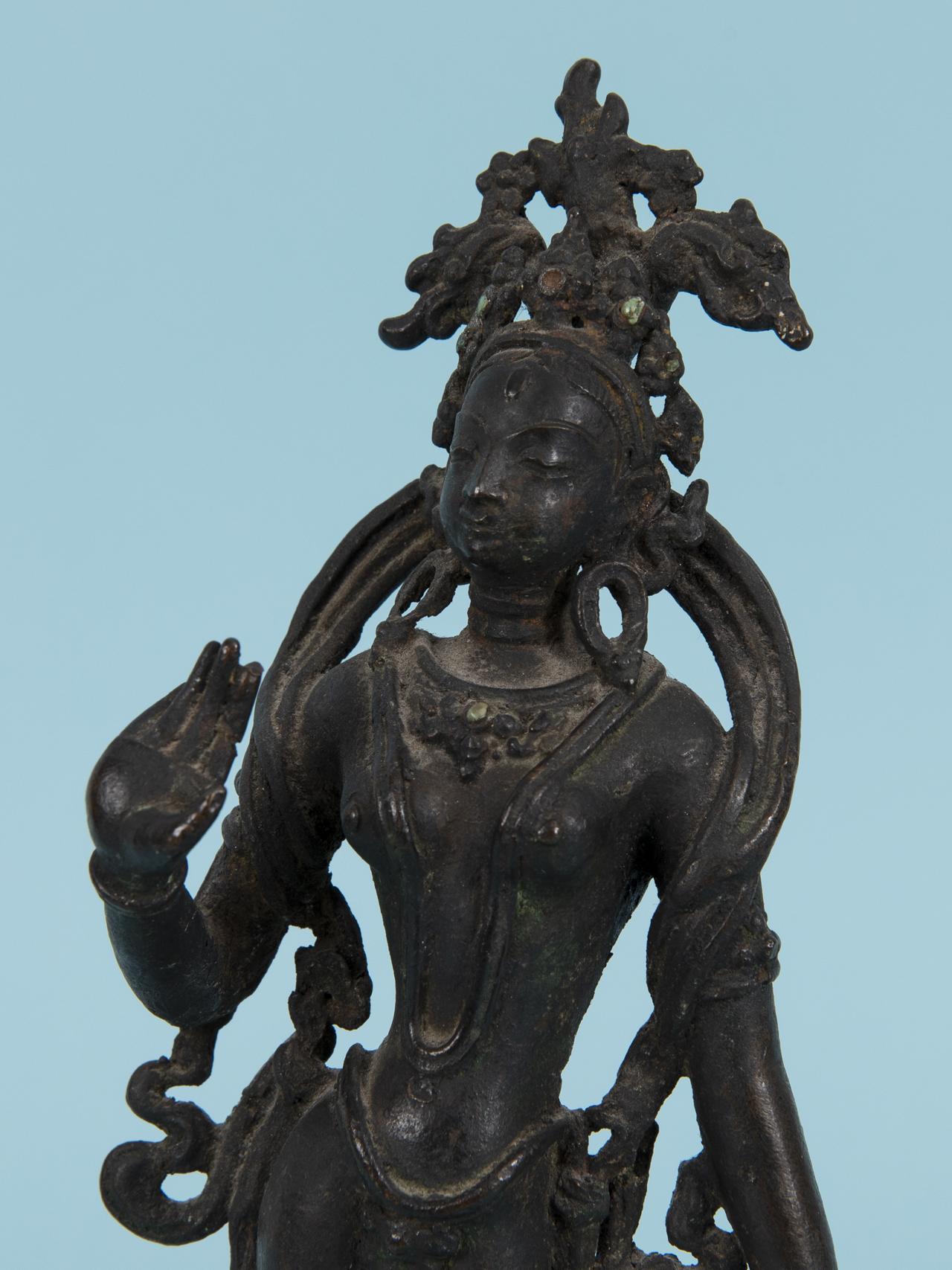
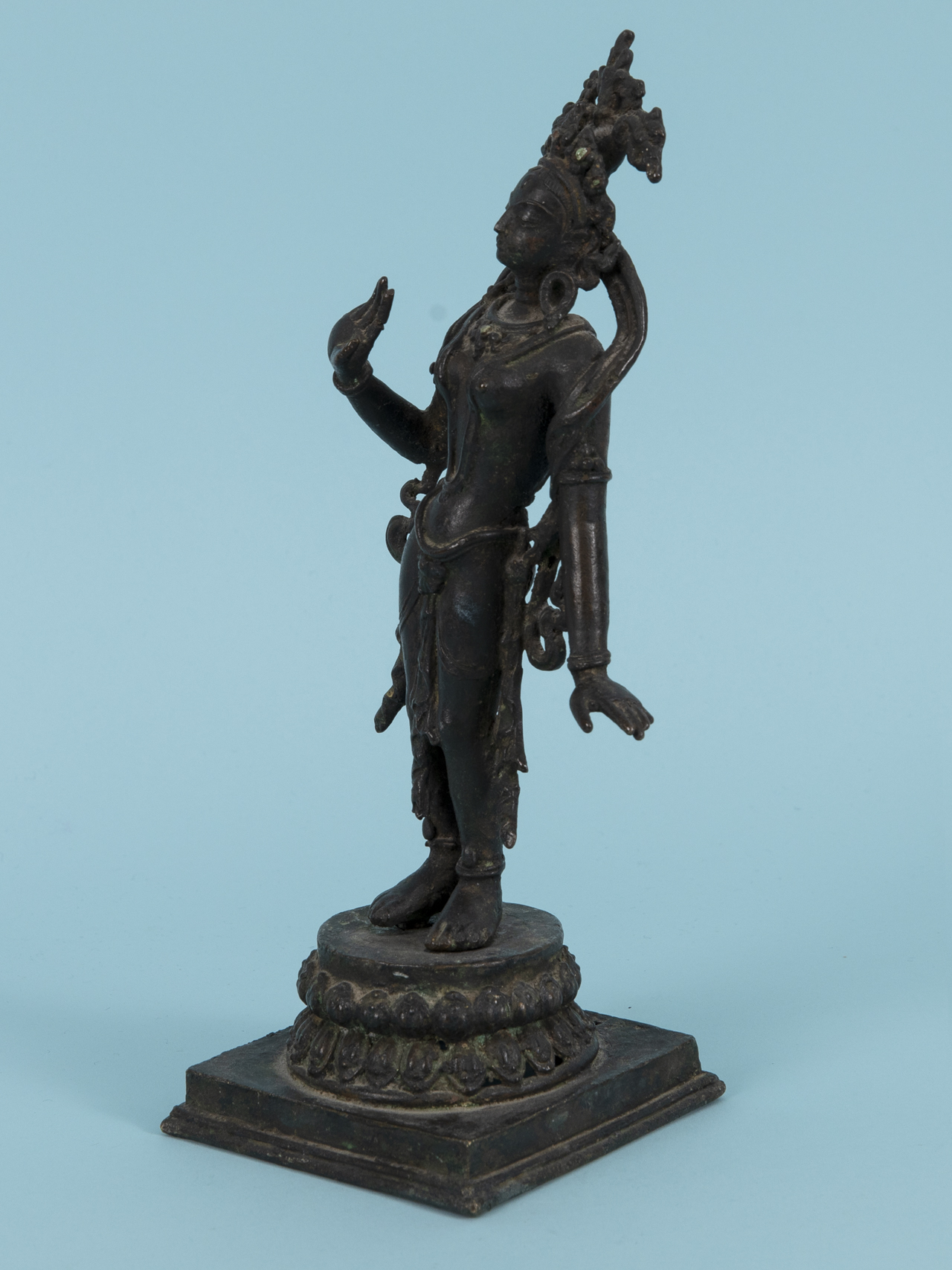
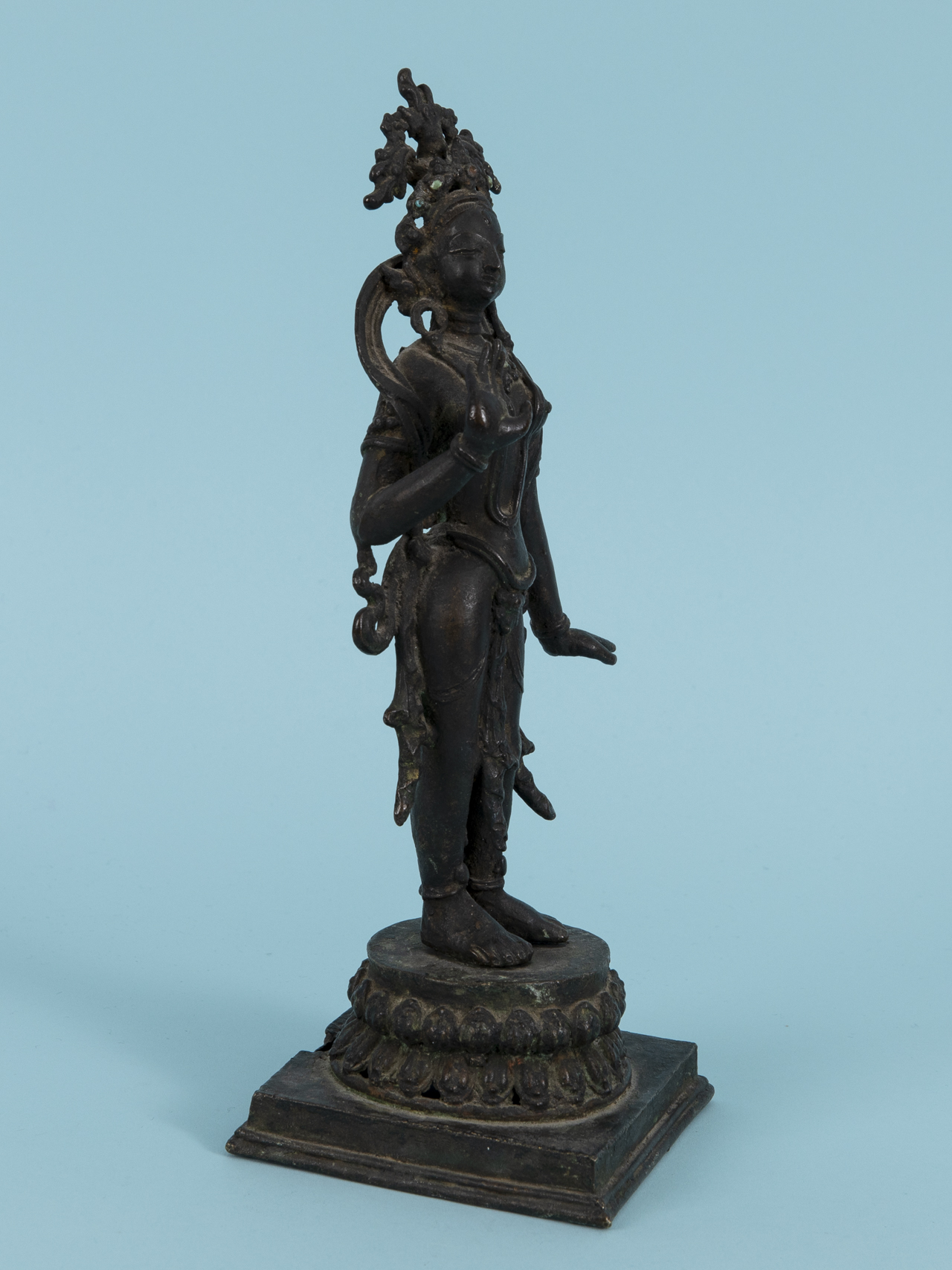
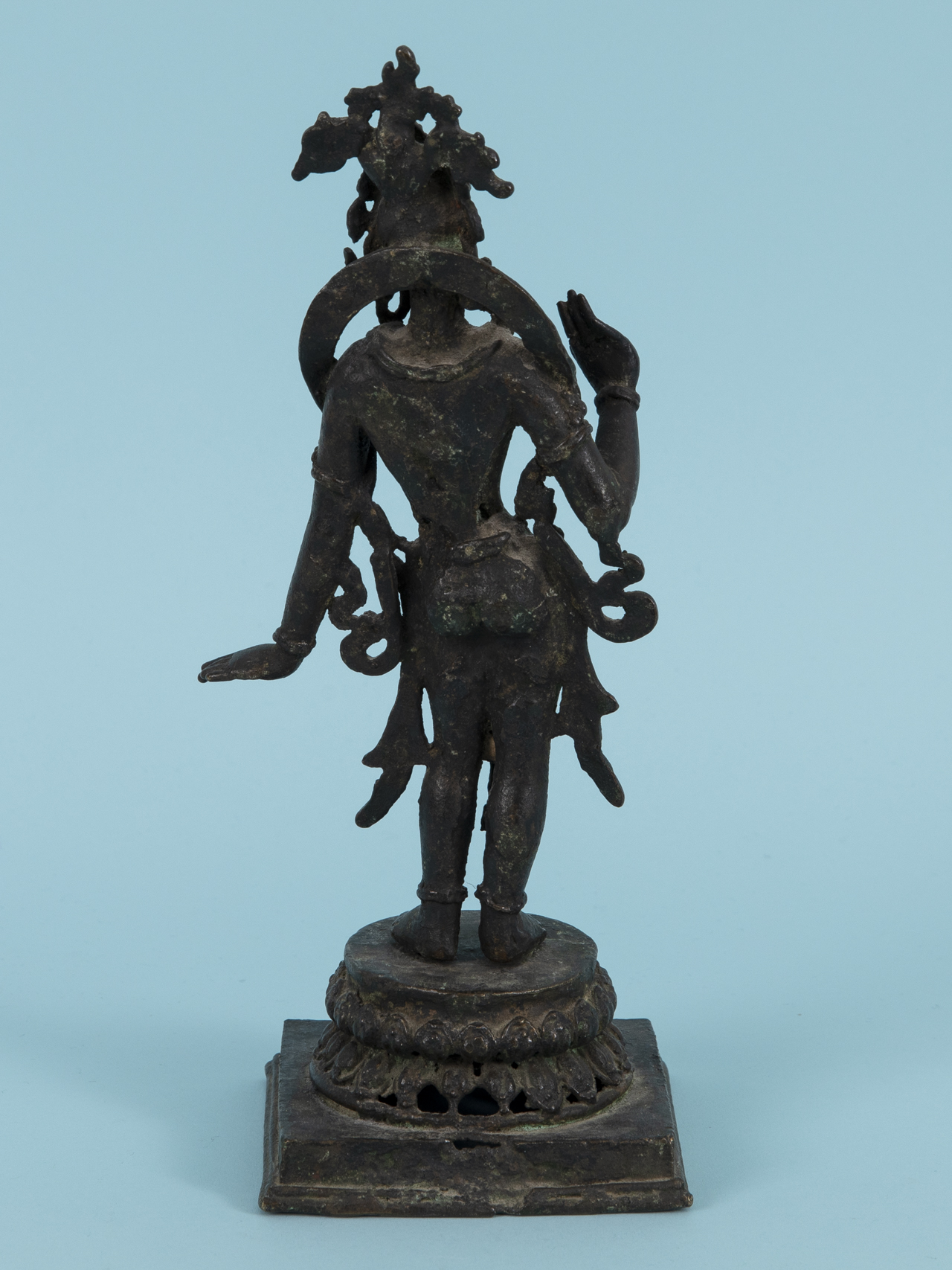
Kleine Standfigur einer Bodhisattva (Tara), Nepal oder Tibet, wohl 18. Jh.
Small standing figure of a bodhisattva (Tara), Nepal or Tibet, probably 18th cent.
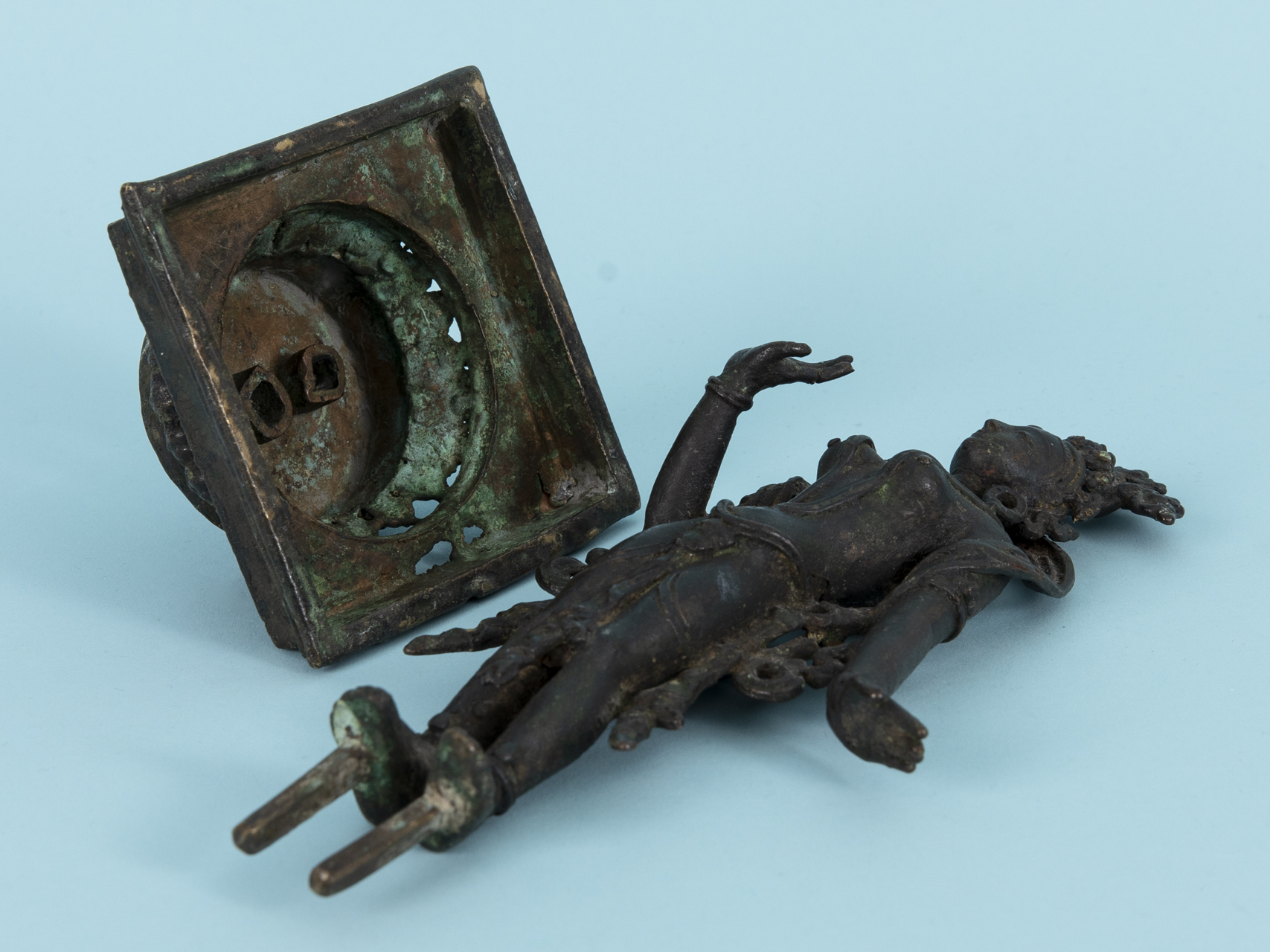
Bronze mit dunkler Alterspatina und Resten kleiner farbiger Steinapplikationen; 2-teilig gearbeitet in Form einer Standfigur und eines Sockels (quadratische gestufte Basis mit erhöhtem Rundsockel); frontal feingliedrig und detailreich gearbeitete Standfigur einer weiblichen Gottheit, auf dem Kopf- und Halsschmuck jeweils mit kleinen punktartigen farbigen Steincabochon-Einsätzen (1 x fehlend, 1 x defekt), verso vereinfacht abgeflacht gearbeitet; unter den Füßen 2 Vierkantstäbe (wohl später ergänzt) zur Steck-Montierung in den Sockel; Sockel verso mit Fehlstellen; Altersspuren; Gesamthöhe: 25 cm; Gewicht: ca. 1,26 kg.
Bronze with dark age-related patina and remains of small coloured stone appliqués; worked in two parts in the form of a standing figure and a base (square stepped base with raised circular plinth); finely proportioned and richly detailed frontal depiction of a female deity, with small dot-like coloured stone cabochon inserts on the head and neck ornaments respectively (1 x missing, 1 x damaged), verso worked in a simplified, flattened manner; beneath the feet two square-section rods (probably later additions) for plug-in mounting into the base; base verso with losses; age-related signs of wear; overall height: 25 cm; weight: approx. 1.26 kg.
Two volumes in a linen-bound slipcase, published by Hoffmann und Campe in 1975 on the occasion of an exhibition celebrating Kokoschka’s 90th birthday in 1976; lithographs, text and colour lithographs on French Rives handmade paper; 1) “Einstein überquert die Elbe bei Hamburg. Five original lithographs by Oskar Kokoschka for the narrative by Siegfried Lenz and a reflection by the author”, containing the signed lithographs in an edition of 26/100: “Blick über die Reling”, “Der alte Passagier”, “Das Paar”, “Die stürzende Frau” and “Frau in Wehen”. 2) “Einstein überquert die Elbe bei Hamburg. A story in three sentences by Siegfried Lenz with a Facsimile of the manuscript, accompanied by five original lithographs by Oskar Kokoschka and a reflection by the author on the artist”, signed by both artists; age-related signs of wear and superficial handling marks; dimensions of the bindings: approx. 35.5 x 45.5 cm; dimensions of the slipcase: approx. 38 x 48 cm; total weight: approx. 4.2 kg.
750/- yellow gold; total weight: approx. 12.7 g; wide, solid ring design; centrally raised and stepped lozenge motif set with 9 pavé-set carré-cut sapphires, framed by a double row of melee brilliant-cut diamonds; on each shoulder 12 pavé-set carré-cut sapphires, laterally contoured by melee brilliant-cut diamond borders; sapphires of intense blue colour variety; diamonds in colour and clarity: upper range; width of the ring head: approx. 18.3 mm; height: approx. 7.6 mm; ring size: approx. 56.5.
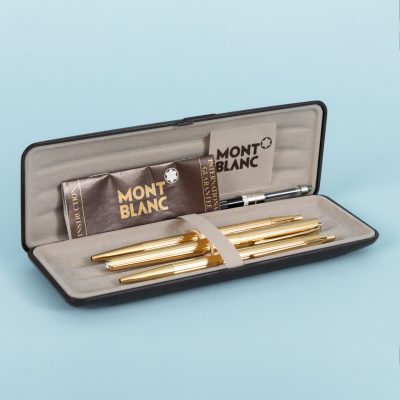
Metal gold-plated with 585/- yellow gold; three-piece set of writing instruments from the “Noblesse” series consisting of: 1) pair of ballpoint pens with fully fluted surface and high-set clip; shaft embossed around “MONTBLANC-NOBLESSE-GERMANY”; Montblanc emblem inlaid in the push button; length: approx. 13.9 cm. 2) fountain pen with fully fluted surface and removable cap with clip and inlaid Montblanc emblem as well as the imprint “MONTBLANC GERMANY”; broad nib stamped “585”; length: approx. 13.8 cm. 3) empty ink converter for fountain pen; length: approx. 7.6 cm. Set with guarantee documents and in the original Montblanc case; age-related signs of wear; total weight: approx. 154 g.
Silver alloy and white porcelain with polychrome painting; weight: approx. 67 g; small lidded box of rounded rectangular form with finely engraved decoration featuring figural and architectural staffage, framed by rocaille ornament, the reverse of the body dated 1740; interior with vermeil gilding and a porcelain plaque set into the lid depicting an exterior scene with putti staffage; porcelain plaque with various cracks and losses; age-related signs of wear, superficial abrasions and oxidation residues; dimensions: approx. 2.8 x 5.9 x 5.2 cm.